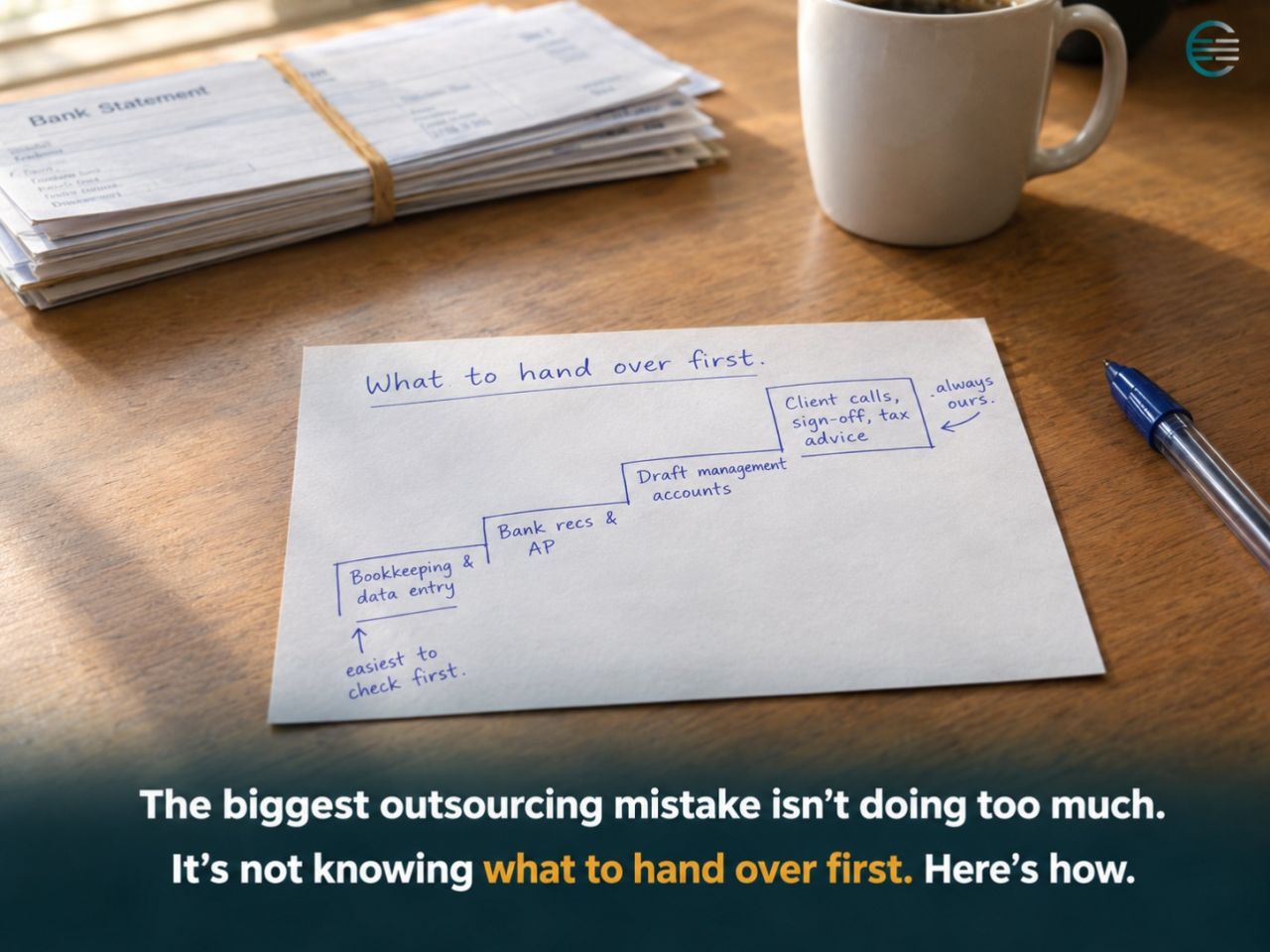
If your practice is thinking about outsourcing for the first time, the biggest mistake isn't outsourcing too much. It's not knowing what to hand over.
Most firms either try to outsource everything at once, or hold onto everything out of caution. Both usually go wrong. The first overwhelms a new relationship before either side has learned how the other works. The second means a firm never actually finds out what the arrangement could do for it.
Here's the catch that resolves the dilemma: not all accounting work carries the same risk if someone new is doing it.
Not All Accounting Work Carries the Same Risk
Some tasks are high volume, repetitive, and simple to check against source records. Get them wrong, and the error is easy to catch before it goes anywhere near a client. Other tasks involve judgement calls specific to a client relationship or a firm's own standards, where a mistake is far harder to catch after the fact and far more costly if it isn't. Scoping a new outsourcing relationship around that difference, rather than around a vague sense of what feels safe, removes most of the guesswork.
| Work type | Risk level | Why |
|---|---|---|
| Bookkeeping and data entry | Low | High volume, repetitive, and simple to check against source documents |
| Bank reconciliations and accounts payable | Low to medium | Routine, and easy to verify against real bank and supplier records |
| Early-stage management accounts and working papers | Medium | Prepared and structured, ready for the firm's own team to give final review |
| Client conversations, final sign-off, and tax advice | Stays in-house, always | Requires judgement calls specific to the client relationship and the firm's own standards |
Why Starting With the Easiest-to-Check Work Matters
This isn't about holding back out of nerves. It's about handing over the work that's easy to check first, so trust is built on evidence rather than hope. A firm that starts with bookkeeping and reconciliations gets a fast, low-stakes answer to the question that actually matters: does the work that comes back hold up against a proper check? A handful of clean weeks on low-risk work is a far better basis for expanding the relationship than a leap of faith straight into higher-value tasks.
Firms that skip this sequencing, and hand over ambiguous, judgement-heavy work in week one, tend to run into exactly the problems that make outsourcing feel risky. Not because the model doesn't work, but because trust was never actually established before it was asked to carry more weight than it could.
Client conversations, final sign-off, and tax advice stay with a firm's own team, always. This isn't a starting restriction that loosens with time. It's a permanent boundary. The offshore model exists to handle production work well, not to replace the judgement a firm's qualified people bring to a client relationship.
How EarthOne Scopes a New Relationship
Map the current workload by risk tier
Before anything moves, we work through what a firm actually does day to day and sort it into the tiers above, so both sides agree on what's moving and what isn't.
Start with tier one for the first four to six weeks
Bookkeeping and data entry move first. Every file gets checked closely, building a track record on the lowest-stakes work available.
Expand into reconciliations and working papers as trust builds
Once the review record on tier one work is solid, the scope extends to bank reconciliations, accounts payable, and early-stage management accounts, still under full review.
Judgement work never moves
Client conversations, sign-off, and tax advice stay with the firm's own team throughout, clearly separated from day one and never renegotiated.
A defined set of production work, clearly separated from the judgement calls that stay with your own team, is what makes this scoping approach work. It gives a firm a way to start without guesswork, and a way to expand the relationship on evidence rather than on a hopeful assumption that it will probably be fine.
Not sure where to start?
EarthOne scopes every new relationship around exactly this kind of risk-based sequencing, published pricing, one month's notice, and full review built in from day one.
Book a free 30-minute consultation